12 rules for life: a personal review

two readings, one book
the first time i picked up this book, Peterson scared me. some may label him as extreme or unreasonable, but i saw the logic and i wasn't ready for it
there's a specific kind of fear that shows up when someone says the thing you already know but been avoiding. you can feel your body and mind filling the gap between fiction and truth, the dissonance
that happened to me. i had a set of fictions about myself and the world, a lifestyle arrangement that worked well enough. and his words… threatened it
the mind doesn't generate fear randomly. it generates fear to protect whatever structure you've built, even if that structure is holding you back
a year later started it again, and the fear was gone. the words didn't change. but i suppose i did. a few walls had come down, the sentences that felt like attacks now felt like raw material i could use
where i was reactive and defensive, where ideas felt like value imposing, now i was creative, and the ideas, tools for building my own framework
this review is about both readings. what i resisted, what i integrated, where i respectfully depart from Peterson to stand on my own ground, and where i state the change on my relationship to authority and value-creation
the thesis
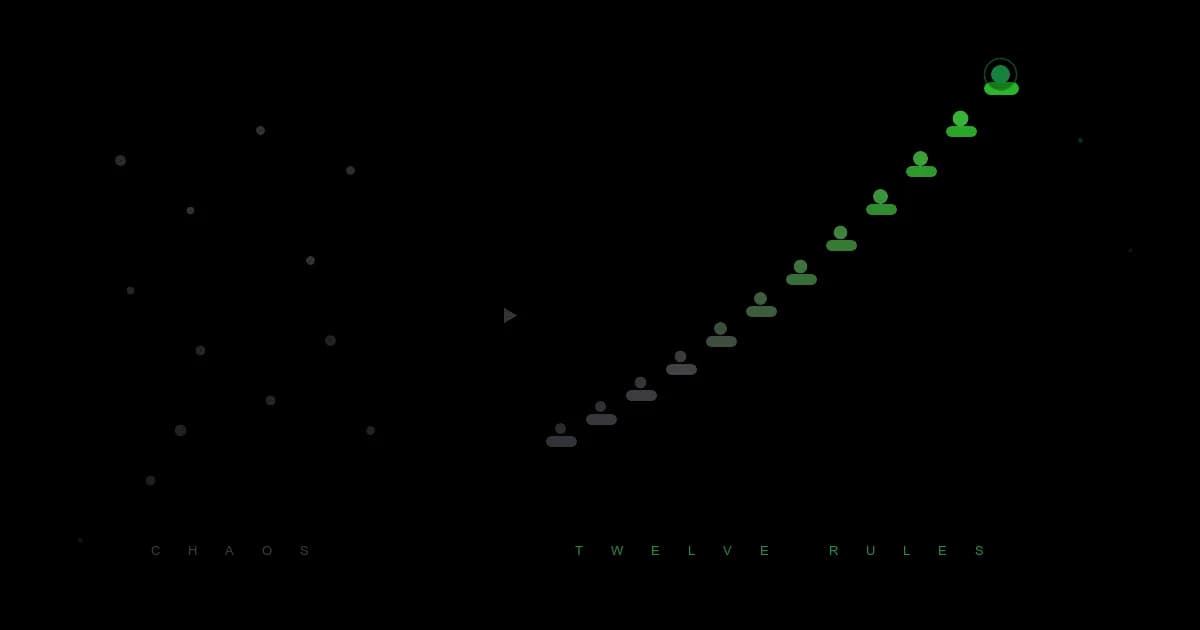
every rule in this book is the removal of a specific psychological safeguard. posture, self-neglect, social circles, comparison, boundaries, hypocrisy, expedience, lying, dismissal, vagueness, risk avoidance, and the inability to notice beauty. each one is a different wall of a mental cage that modern life builds around us through comfort, overprotection, and the systematic habit of adapting our environment to balance our bodies and minds instead of regulating our bodies and minds to balance with the environment
we ended up in a world where we feel we have little power of decision, ownership, or influence. but we do. and that power is earned through discipline, but also through understanding the basics of animal and human behavior, not forgetting where we come from
Rule 1: stand up straight with your shoulders back
Peterson's argument is biological. lobsters, serotonin, dominance hierarchies, feedback loops between posture and neurochemistry. i don't think humans work in exactly the same way. we probably developed more complex mechanics for a reason. but what the rule actually gives you is something more valuable than the biology: self-awareness
when you can look at yourself from the outside and understand how you pose to the world, you start understanding how other people see you. and if you want to change something, you can start dealing the cards. it's not about the specific posture he proposes, it's about what being aware of your posture gives you. a small awakening that if used correctly compounds
the world we live in is layered, and we can jump between layers as we please. the important thing is knowing how to navigate it. you don't need a cannon to kill an ant. shrinking yourself down is a misread of the situation, a default response from someone who hasn't learned to calibrate. it's not that you need to walk into every room like you own it, it's that you need to know which version of yourself each room requires and have access to all of them. when you're unaware of how you carry yourself, you're stuck on one layer, reacting instead of navigating
standing up straight isn't about dominance or entering some competition. it's about having the full range available to you. the person who only knows how to shrink has one tool. the person who's aware of their posture, their presence, how they're being read, can move between layers deliberately. that's the real value of this rule. not the posture itself, but the navigation it unlocks
Rule 2: treat yourself like someone you're responsible for helping
people give medication to their pets more reliably than they take it themselves. Peterson says this comes from a belief that you don't deserve care, partly from knowing every terrible thing you've done and thought
this talks a lot about something that i call "personal karma". if you know something is bad and you do it anyway, the backlash hits harder the more aware you are. the same goes for the positive. the more conscious you are of doing the right thing, the more it compounds. when there's a split between what you know and what you do, your unconscious starts working against you. closing that gap, making thought and action one thing, is what removes the internal friction. you'll still make mistakes, but at least you're facing forward. it's incredible how fast that backlash comes at 34
you're not avoiding self-care because you hate yourself, you're avoiding it because self-care would remove the excuse
once you start seeing yourself as a vessel for something larger than your own story, call it god, universe, or whatever sits right with you, caring for yourself gets simpler. it stops being about whether you "deserve" it. your body is a tool for exploration and growth and building toward a vision bigger than you. you don't neglect a tool you need. you take care of it, you grow it, you strenghten it
Rule 3: make friends with people who want the best for you
i used to think this advice was superficial and self-interested. choosing friends based on what they give you felt transactional. but the truth is simpler than that: if you seek people who want the best for you, you start wanting the best for people. we humans copy everything. the best way of becoming the best version of you is encouragement but also the space to try that best version, and although you can probably do it against the environment, leveraging environment to make a bigger impact is the smartest decision
this doesn't necessarily mean leaving everyone behind. but it means understanding that we all have a budget of time, and we have to be mindful how we use it to make an impact. if you are not helping someone or getting anything from someone, even the most basic companionship, and instead you are getting something negative, then it's not your place. and if you get inspired by people who hate you, you really need to work on yourself
Peterson frames this somewhat binary. good friends, bad friends, choose better. but the real principle is directionality. are the people around you moving, and are they moving in a direction that pulls you forward or drags you into stagnation?
you also can't allow other people to go over you every time. that's not generosity, that's an arrangement that protects you from the vulnerability of asking for what you actually need
there's a pattern in certain social groups where people collectively agree that ambition is arrogance, that success is suspicious, that staying comfortable together is solidarity. anyone who leaves is a traitor
building something requires breaking from that consensus, and that's lonelier by nature
Rule 4: compare yourself to who you were yesterday, not to who someone else is today
comparison to others is an infinite losing game. you're comparing your full internal experience against someone else's curated external output. the categories don't even match
i think you can use others as guidance, but the fight is always with yourself. the growth can only be measured by yourself. any other life wouldn't make meaningful anything that has happened in yours. i don't compare my progress with others, but i do like to choose inspirations for where i want my life to go and decide what to actually do with it. i have a vision and i'm building toward it every day, and that process makes it clearer and clearer
there's a difference between "i want to build something like what that person built," which is creating toward a vision, and "i should be where that person is by now," which is having your value defined by someone else's timeline. the first is useful, the second is poison
and honestly, for men at least, self-improvement never ends. it's not a phase you complete and then arrive somewhere. "i'm always getting better" isn't avoidance, it's the condition. you contribute while you grow, you grow while you contribute. the two aren't sequential, they run in parallel.
waiting until you're ready is the real avoidance. you're never ready. you just go
Rule 5: do not let your children do anything that makes you dislike them
this isn't authoritarian parenting. it's about protecting the relationship by being honest about what behaviors make you withdraw love, and addressing them early. unspoken dislike is more destructive than clear boundaries. if your child is unlikeable to you, they'll be unlikeable to the world, and the world won't be patient
i don't have kids, but i understand the concept beyond parenting. you should make sure everyone knows your boundaries better earlier than later. people get used to the space you give away, same as kids. and that connects to rule 1. posture, boundaries, the space you occupy. you either define the territory or someone else defines it for you, and then you resent them for it, which is your fault not theirs
a child who never meets real boundaries develops an inferiority complex masked by entitlement. they expect the world to adapt to them. there's the thesis again: environment adaptation vs self-regulation
the parent who avoids discipline is operating from fear of their child's displeasure. the tantrum, the "i hate you." so they submit. but submission to a child doesn't produce a free child, it produces a tyrant with no skills. accepting your child's temporary hatred is the cost of building someone who can function
Rule 6: set your house in perfect order before you criticize the world
i agree with Peterson 100% on this one. i hate hypocrisy, and i find myself more often than i'd like doing exactly this. giving opinions or telling off people for doing things i still do. however, i am catching myself more often, and i do it less compared to before
the best defense against hypocrisy isn't vigilance, it's having strong values. when you have a clear idea of why you protect an idea and you defend it with your actions and your words, it becomes easier every time. the gap between thought and action closes, and hypocrisy has less space to exist
but there's a trap. "i catch myself more often now" can become its own fiction. the person who monitors their hypocrisy expertly but still does it has just added a layer of sophistication to the same arrangement. catching yourself is step one. stopping is step two. self-awareness is not a substitute for behavioral change
the hypocrite always needs an audience. they perform the value for others while privately living differently. the integrated person doesn't need to perform because the value and the action are the same thing
most people who rage against the system haven't done the basic work within their own reach. the room is a mess, the relationships are neglected, the body is ignored, but the opinions about how the world should run are strong. criticizing the world feels like contribution. "i see the truth others can't" is satisfying to the ego but produces nothing. the person who quietly fixes their local sphere does more for the world than a thousand critics
Rule 7: pursue what is meaningful, not what is expedient
i get where Peterson goes with this. it's about long-term thinking, even if you are 100% certain you are going to die tomorrow
but i also think we need to understand what is expedient for us and use it for what is meaningful. because if we don't, we can dedicate our lives to hard enterprises instead of using our talent, ability, and genius to add value to everyone around us
Peterson presents expedient and meaningful as opposites. i think that's incomplete. your natural talent, what comes easy to you, can be the vehicle for meaning rather than the enemy of it. the will to create isn't about choosing the hardest path, it's about channeling all available force toward building something. grinding against your own genius "because it should be hard" is its own form of weakness disguised as virtue. suffering as a performance for yourself
your natural abilities aren't accidents, they're tools for contribution. the person who ignores their talent to pursue something artificially difficult is often protecting themselves. "if i choose the hard path and fail, at least i was brave" is a fiction that shields you from the scarier question:
what if i use my actual talent fully and it's still not enough?
the test is whether the path still contains friction. if it's all flow and no resistance, you might just be comfortable. but if it's flow with challenge, that's where meaning and talent converge
Rule 8: tell the truth, or at least don't lie
this is a difficult one. when you are really honest with yourself, you realize you are lying in a lot of small things all the time. i've cut on this strongly and i work hard to fix it
what still bothers me is that i don't always know how to say the truth. the ideal would be to be honest 100% of the time, but sometimes i tend to hurt unnecessarily by saying "my" truth. and i think compassion for this is key
Peterson makes a distinction most people miss. he's not saying always tell the truth. he's saying at minimum stop lying. those aren't the same thing. you might not know the full truth, you might not be ready to speak it, but you always know when you're lying. the lie is conscious. you feel it in your body
there are three things most people collapse into one. honesty: accurate representation of what you observe and feel. truth-telling: volunteering that information when it affects others. weaponized truth: using accurate information to establish dominance, punish, or prove superiority. that third one is what i catch myself doing sometimes. "i'm just being real" is one of the most common covers for aggression. the person who "tells it like it is" often enjoys the impact more than they care about the accuracy
if your truth is reactive, if it's "i need to tell you what you did wrong," it's oriented toward the other person, which means they're still the reference point. real honesty is declarative and self-directed. it doesn't need to correct others
choosing not to speak isn't a lie, it's judgment
Rule 9: assume that the person you are listening to might know something you don't
this is a complex one. i think you need to do this, but you also need to assume that the person you are listening to may not know anything about what they are talking about at the same time. most people talk about things they don't know. and this happens with professionals too, they do not listen so they talk shit
the key word in Peterson's rule is "might." it's a probabilistic stance, not a submissive one. assume they might know something. not that they definitely do
but receptivity without discernment is just gullibility. real listening requires investment, and investment requires selection. you can't go deep with everyone on everything. that connects to rule 3: choosing your environment includes choosing which conversations deserve your full presence. the rest get courtesy, not depth. that's not arrogance, that's resource management
the real skill isn't assuming they know or assuming they don't. it's suspending the assumption entirely until you've actually heard them. that suspension is hard because it requires tolerating uncertainty, and tolerating uncertainty is what separates the integrated person from the defensive one
the person who can't listen is trapped in their own framework. they already know what the world is, so new information is threatening rather than useful. the inability to listen is a safeguard against having your model disrupted
the person who talks over everyone and already knows everything is performing strength because they're afraid of being revealed as ignorant. real security absorbs new information without feeling threatened. the strongest position in any room is "i might be wrong, show me." but only if you mean it and only if you're actually interested in the outcome
Rule 10: be precise in your speech
i agree with this completely. vague language isn't just poor communication, it's poor thinking. when you can't articulate something precisely, you don't actually understand it. and vagueness lets problems stay undefined, which means they stay unsolvable
i'd add that you also need to make sure the other person understands the words of emphasis in the same way you understand them. precision is meaningless if the receiver decodes it differently. so you may want to have feedback when you give directions or advice
vagueness is protection. if you never define exactly what you want, you can never precisely fail
precision is an act of creation through language, carving something defined out of chaos. vagueness preserves optionality at the cost of meaning. the vague person can always claim they got what they wanted, or that the goalposts were somewhere else. precision is a commitment, and commitment is exposure
this rule probably applies most honestly to my own life when it comes to articulating what exactly i'm building toward. i know it has to do with honest action, alignment between thought and behavior, contribution to something larger than myself. but compressing that into one precise sentence is still work in progress. and acknowledging that gap honestly is more in the spirit of this rule than pretending i have it figured out
Rule 11: do not bother children when they are skateboarding
this isn't about skateboarding. it's about risk. children and people in general need to encounter danger to develop competence. a society that removes all risk produces people who can't handle any
we need exploration to trust our own senses. if not, we develop a mental cage. and that cage isn't theoretical, it's built one avoided experience at a time. the body learns limits that aren't there
this connects directly to the opening thesis. the world doesn't need to oppress you if it can just pad every corner until you never develop the capacity to resist anything. overprotection is environmental adaptation performed on someone else's behalf. it feels like love but it's actually theft. you're stealing their opportunity to become competent
overprotection produces the same result as neglect: an adult who can't function. the sheltered person never develops courage because courage was never required. they arrive in adulthood with an inferiority complex and no tools to address it, because every challenge was preemptively removed
safetyism is weakness disguised as care, scaled up to a society. the highest value becomes harm prevention rather than capability development. the skateboarding kid is doing something important without knowing it: testing himself against reality on his own terms, accepting the risk of injury as the price of mastery
Rule 12: pet a cat when you encounter one on the street
Peterson talks here about what to do when life is genuinely terrible and no amount of discipline or meaning-making fixes it, probably one of the quietest and personal he wrote
his argument: when suffering is real and unavoidable, you shrink your timeframe. you stop trying to make sense of the year or the month. you make sense of the next hour. and if a cat crosses your path, you pet it
i would add: stare at the sunset, smile at the waiter, or anything of the sort. and not only when life is terrible
this is where i respectfully depart from Peterson. i don't take sorrow as an excuse. i've suffered, and i don't need to catalog it to prove the point. but i think if you only wait for moments where you feel bad to do these things and expect a smile from nature, you are losing the most beautiful thing about life. i pet the dog, i watch the sunset, i notice the small things not as crisis medicine but as daily practice, in any state of mind. it's a habit that keeps my life balanced
Peterson frames the cat as emergency protocol. i think that framing, while coming from genuine pain, risks romanticizing suffering as the gateway to presence. the person who only notices beauty when everything else is broken has built a reactive relationship with life. the person who notices it constantly has built a generative one
the person who pets the cat only when suffering is still making it about themselves: "i need this moment." the person who does it regardless has moved past the self-referential frame
presence shouldn't be the exception purchased by pain. it should be the baseline
closing
this book hit me at the wrong time, and then it hit me at the right time. the difference between those two readings is the difference between reacting to ideas and using them. the first time, Peterson's words were an external authority threatening my arrangements. the second time, they were material for my own construction
every rule is a safeguard removed. posture, self-neglect, bad company, comparison, weak boundaries, hypocrisy, expedience, lying, dismissal, vagueness, risk avoidance, and the inability to notice beauty. twelve walls of one cage
the cage is built by a world that has systematically adapted the environment to us instead of asking us to adapt ourselves. and breaking out isn't a single act of rebellion, it's the daily compounding of small awakenings. awareness of your posture, awareness of your speech, awareness of who you spend time with, awareness of what you're avoiding
i don't agree with everything Peterson says. i think his biological determinism overreaches. i think his framing of suffering as the primary teacher underestimates the power of presence without pain. i think some of his frameworks would benefit from more precision and broader scope
but the core of what he's saying is hard to argue with: stand up, take care of yourself, choose your people, measure your own growth, hold your ground, clean up your act, build something meaningful, stop lying, listen, speak clearly, take risks, and notice what's still beautiful
we need to stand up and do something better with the world. but first we need to do something better with ourselves. not because self-improvement is the goal, but because an unregulated instrument produces nothing worth hearing