why i started QuantaKrypto

dated June 3, 2026, when i started the website repository · this retrospective was written October 12, 2026
i had spent twelve years working with blockchain and cryptographic systems when i decided to close my business and started researching where i wanted to go next
i wanted to move into a new field, and i gave myself time to study. the quantum threat to Bitcoin caught my attention. it was close enough to the systems i knew that i could see why it mattered, and unfamiliar enough that i had a lot to learn
the more i read, the more the question changed. how would a system built around cryptographic assumptions migrate when those assumptions stopped being sufficient? what would need to happen before that point, and what could already be lost by waiting?
that research became QuantaKrypto
Bitcoin was the starting point
Bitcoin made the signature problem concrete for me. ownership depends on being able to authorize a spend without giving someone else the ability to produce that authorization
a sufficiently capable quantum computer changes the assumptions behind elliptic-curve signatures. an exposed public key could become enough to recover the corresponding private key and forge signatures. the practical exposure depends on the output, key visibility and the rules in effect when an attack becomes possible
that is different from decrypting the blockchain. Bitcoin's ledger is already public. nor does forging a signature automatically rewrite confirmed history. the concern is future authorization under keys that the system still accepts
from there i started looking beyond Bitcoin: private communications, software updates, certificates, identity systems and records that need to remain trustworthy for years. the same families of cryptography appear in many places, but the consequences and migration paths differ
the two risks that kept my attention
harvest now, decrypt later is about confidentiality. an adversary stores encrypted traffic or data today, hoping to recover its contents later. information can remain sensitive far longer than the systems that first encrypted it. changing those systems in the future cannot remove copies someone already holds. NIST describes this recording threat as a reason to prepare before a cryptographically relevant quantum computer exists
harvest now, forge later is how i think about the related authenticity risk. public keys and signed material can remain available for years. if the signature scheme becomes breakable, an attacker may be able to create new signatures that verify under an old identity
the timing is different. forgery requires the future capability, and a public key may already be available without any harvesting. whether a forged record is accepted also depends on trusted timestamps, key retirement and verification policy. NIST's transition draft distinguishes the migration issues for signatures from the recording risk for encryption
both problems made long-lived trust interesting to me. what has to stay confidential? what has to remain authentic? for how long? those questions are more useful than treating every cryptographic use as the same migration task
the gap i saw
there was serious research and standards work already happening. the gap i saw was in how much attention these risks received in everyday engineering and business decisions
in the market i was looking at, too much of the discussion stopped at whether quantum computers were near or far away. i wanted to work on the questions a team can answer now: where its cryptography is, which data has a long confidentiality lifetime, what depends on long-lived signatures, and how difficult those dependencies will be to replace
a team does not need a confident prediction of the arrival date to begin that inventory. it needs a reasonable view of its exposure and the work a migration would require
turning the research into a practice
QuantaKrypto grew out of that direction: applied research, assessment, open tooling and education around post-quantum migration
i wanted the work to be inspectable. if a tool flags a problem, someone should be able to see why. if an assessment makes a claim, it should identify the evidence and its limits. if a proposed change improves one part of a system, it should say which other parts remain classical
the website repository began on June 3, 2026. pqc-tools followed on June 9, giving me a way to turn some of those questions into repeatable engineering work
for me, this was a way to take the experience i had built over twelve years and use it to study a problem that deserved more practical attention. i wanted to understand it well enough to help people start making changes while they still had time to choose how
similar posts
crypto-agility.json: a place to publish cryptographic posture
oct 11, 2026
Deadline aware hybrid optimization for ISP traffic engineering
oct 11, 2026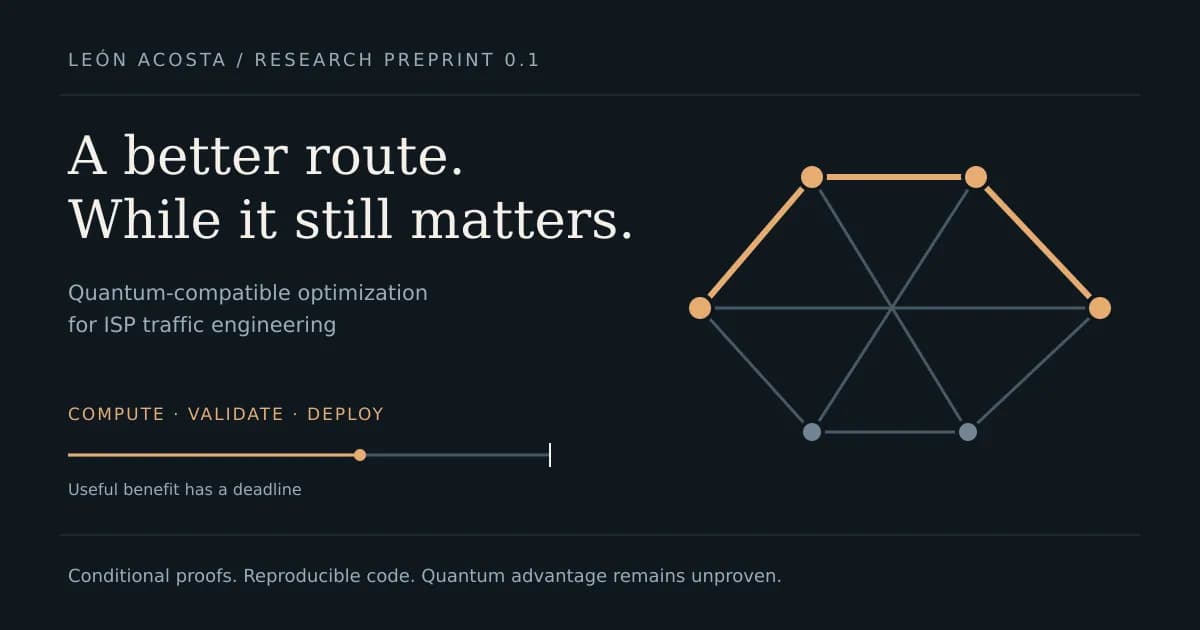
making post-quantum signatures faster
oct 12, 2026
nostr is centralizing. by design
mar 5, 2026
my post-quantum proposals for Nostr
aug 17, 2026
post-quantum authentication in Prague
oct 12, 2026