on the misconception of the senses

we don't actually know how we learn most of what we know. not the school version, the deep one: how a taste became "good", how a sound became "music", how you came to trust your own eyes. you never sat down and decided any of it. it got installed, mostly before you could question it, and then you ran on it for the rest of your life
from very early we get handed a manual on how to live. our parents got theirs from their parents, and we absorb their likes and dislikes mostly intact. somewhere in there we stop reading our own body and start trusting that manual instead. we like what we're told to like, what looks good online, what the people around us like, and we bury the signal that would have told us what we actually feel
the mind helps this along, because matching what other people like is how we connect, so it gets wired in and reused as a default. the same machinery that smooths social life also smooths perception, it gives you the easy version of what's happening instead of the raw version
after years of actually asking people, i realized most of us have never once questioned that feed: the filter is the world to us
my claim
your senses don't record reality, they sample it. your body has a limited set of sensors, like any machine, and your brain takes those samples and builds a best guess. most of the time the guess is good. but you can catch it guessing, and once you do you can't unsee it
everything below is checkable. none of it needs a lab. it needs a glass of water, two objects, and your own nose
on sight
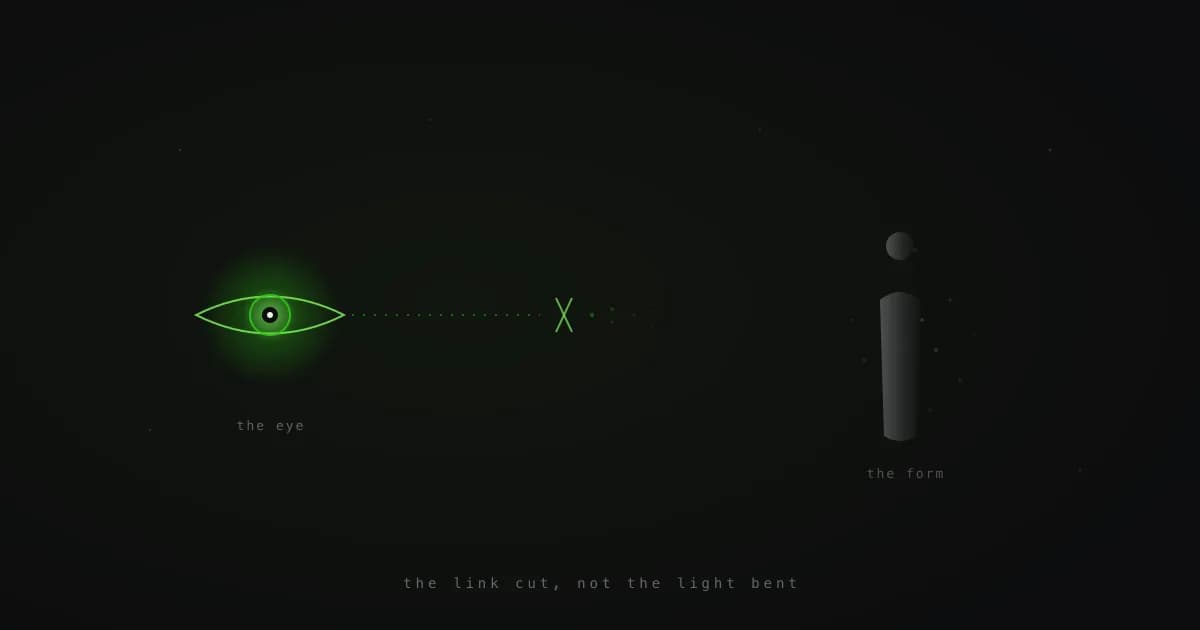
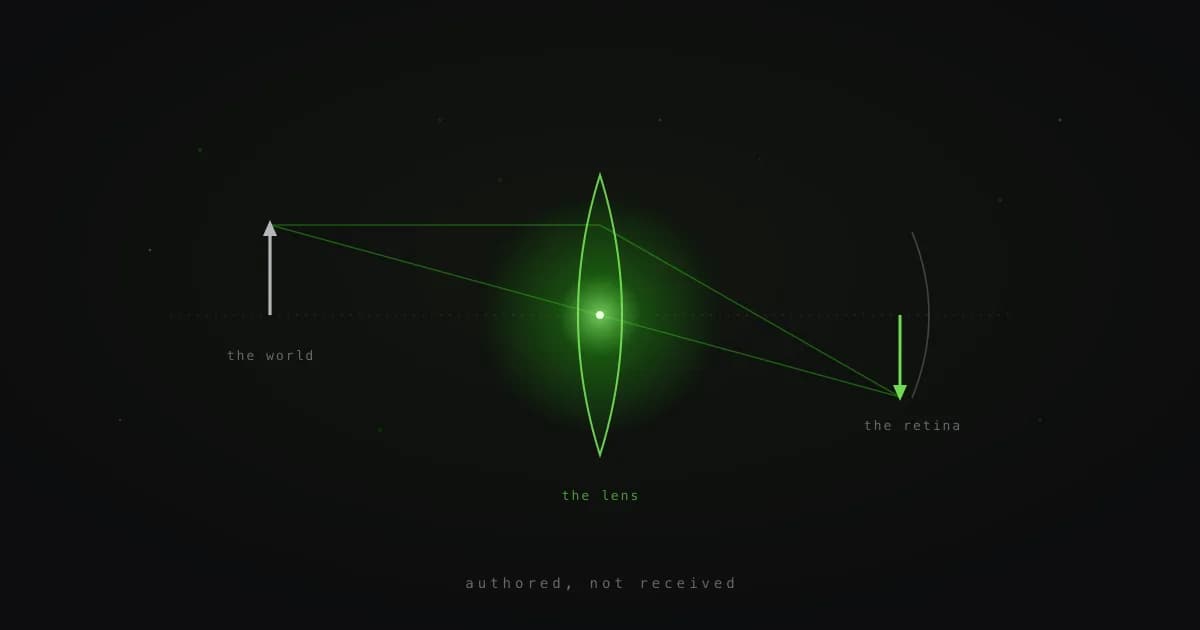
your eye is a sphere with a lens at the front. that lens bends and flips the incoming light, so the image landing on the retina at the back is upside down, left-right reversed, and flat. and you have two of them, each catching a slightly different flat image from its own angle. you experience none of that. you experience one upright 3d world with depth. your brain built that, partly from the offset between those two flat images, plus motion, shading, and the way near things block far ones. it's really the best guess your brain has a difficult time admitting is making
what you see is authored, not received
test it: hold two pens at arm's length, close one eye, and try to touch the tips together in a single motion. with one eye you'll miss more than you expect, because you just removed one of the main depth cues. open both eyes and it's trivial again
this is also why optical and audio illusions work. they aren't glitches, they're the reconstruction being fed input it resolves the wrong way. the illusion is the seam showing
on touch
there is no wetness sensor in your skin. you cannot directly feel wet. what you feel is a drop in temperature plus a change in texture and pressure, and your brain labels the combination "wet"
test it: this is roughly why float tanks work, they saturate the water with epsom salt for buoyancy and hold it at skin temperature, around 35c. with no temperature difference and your body floating still, the wet feeling mostly disappears, you only get it back when you move. weaker version at home: run a sink to lukewarm, hold a finger still in it, and notice how little "wet" there is until the temperature or the movement of the water gives it away
texture is the same kind of trick. press a fingertip flat against a surface and hold it still, you can barely tell rough from smooth. drag it even a centimeter and the texture appears instantly. your skin needs motion to sample the surface, static contact gives it almost nothing
test it: close your eyes, rest a still finger on your jeans, a wooden table, a phone screen, and try to name which is which without moving. then move
the rest of touch is assembled the same way. sharpness is your skin reading how much area the pressure is concentrated into. oiliness is texture plus how the surface pulls heat from your skin. weight is your joints and muscles reporting load plus your own sense of how much effort you sent to lift it. none of these are single dedicated senses
on taste vs flavor
this is the cleanest one to test. your tongue only reports a few basic tastes: sweet, salty, sour, bitter, savory. everything else you call "flavor" is mostly smell, picked up through the back of your nose while you chew. flavor isn't something your mouth detects, it's something your brain assembles from taste plus smell plus texture plus temperature
test it: pinch your nose shut and eat something with a strong flavor, a jelly bean, a piece of fruit, coffee. you'll get the basic taste and almost nothing else. let go mid-chew and the flavor floods back in. that flood is your brain finishing the assembly
the point
so the point isn't that you're doing it wrong. the point is that what you call seeing, touching, tasting is already an interpretation, built partly by your body's hardware and partly by the manual you were handed. you can keep running on the manual, or you can start checking the raw signal yourself
your brain is a pattern-recognition machine running best guesses. once you know that, you get to decide which guesses you keep
the funny part
you're not separate from the sound or light wave, you're touching it directly, more directly than anything else. the photon lands right on your retina, the air pressure pushes right on your eardrum, that's raw physical contact with the actual signal. and yet none of what shows up in your head looks anything like a wave
light is just oscillation, sound is just air moving, both completely colorless and silent on their own. you're in direct contact with a ripple and your brain hands you red apples and music. so the punchline of the whole essay is this: you're literally touching the raw signal, the most honest contact you'll ever have, and your brain still can't resist repainting it into something it isn't