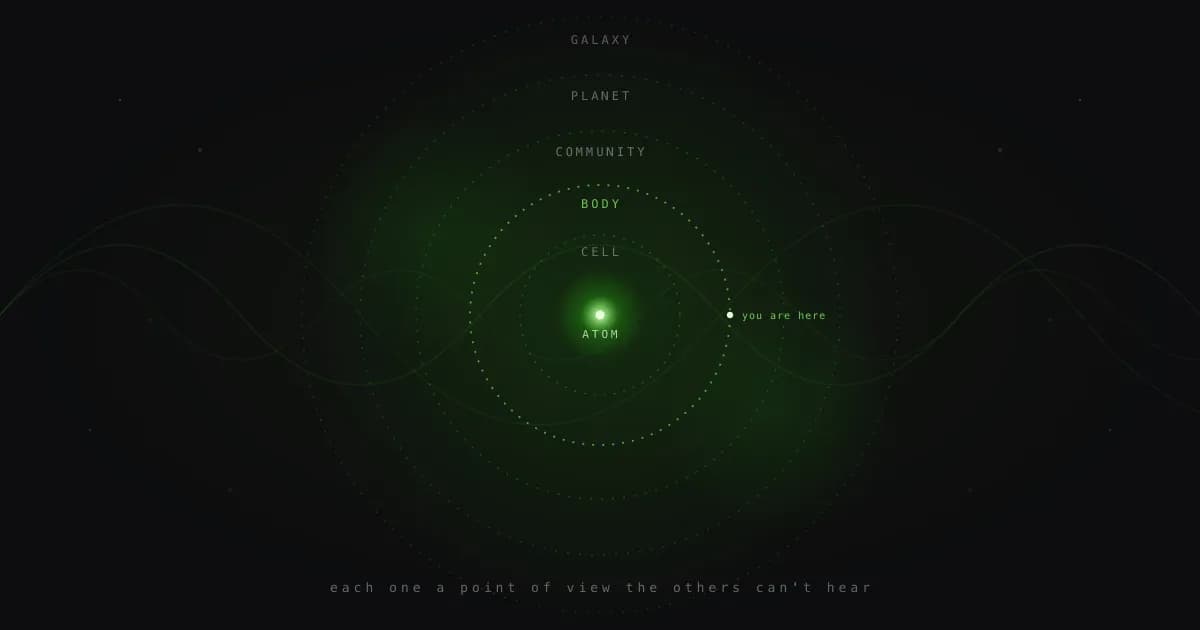
consciousness as a nested perspective

consciousness lives at every level of being, not just the one we happen to see from. we fully grant it to humans (or at least some), hand a smaller portion to other animals, a bit to plants, and draw the line there. that line is arbitrary, and it's arbitrary because we can only see from where we stand
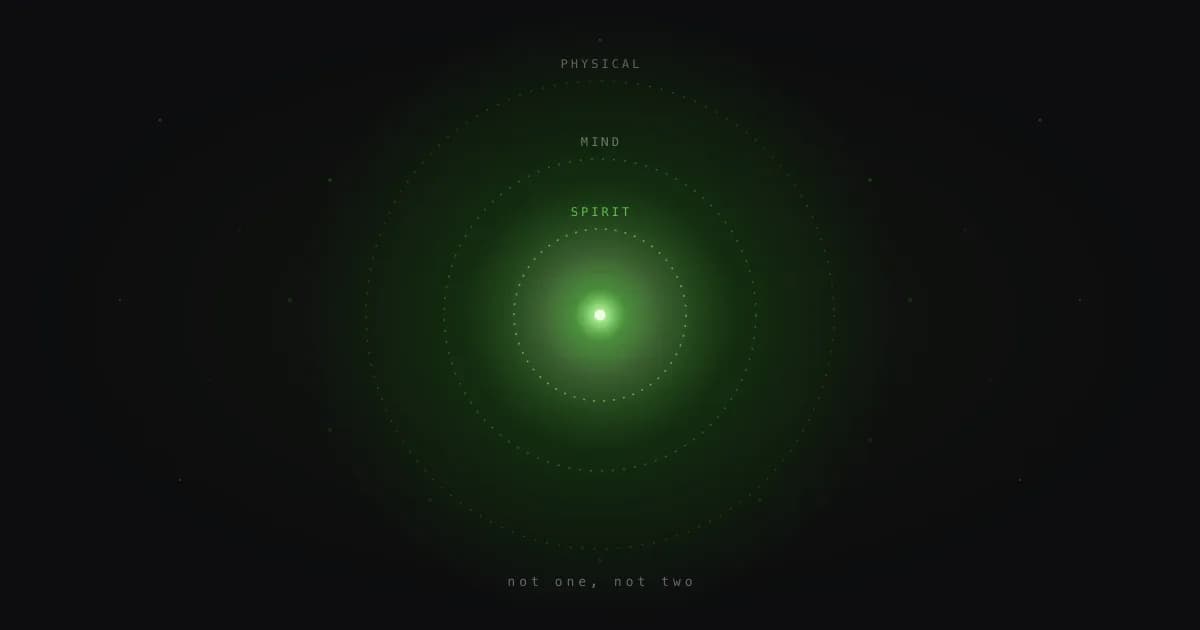
when i say "level", i do not mean there's top or bottom, bigger or smaller, better or worse. that's not it. these aren't floors stacked above and below each other, they're perspectives nested within each other, sounding at the same time
think of a chord. the notes aren't ranked, no one of them is more real or more alive than the others, they're just different sound waves happening all at once, and a combination of sounds is what you hear. that's how i mean it. the cell isn't beneath me and the planet isn't above me, we're all playing together right now, each one alive in its own register, each one a point of view the others can't quite hear
i'll start with my body. it gives "me" a level of consciousness, the one that "connects" me to the larger universe. but hey, my body isn't a single thing. it's systems and organs that run on their own, mostly without asking me. they talk to each other, they coordinate, and they do it in a way that's self-organized rather than commanded
my organs are made of smaller systems with parts, those parts of cells, and every cell lives a full life of its own, independent and collective at the same time, needing the others and being needed
go further and you reach molecules, then atoms, things we call stable, but they still react, still shift, still respond to what touches them. they behave, in their own register, like they're alive. and you could go further in…
my human body doesn't exist alone, "i" doesn't exist alone. for starters, i needed at least two other humans to even arrive here. so, we humans, build communities, economies, whole webs of supply and care, and none of it survives without the environment holding it up. we treat all of this as separate, but the body needs its head no more than it needs the water supply, vegetables, meat, or a way to get them. infrastructure, service, a butcher and a groceries store. my body needs the different parts of the world as much as i needs every cell that makes me working in a specific role
keep going and you get ecosystems, mountains, rivers, rain, the seas, an entire planet that behaves like one living organism with its own way of sensing, senses we can't read because we're standing at the wrong scale to read them. and the planet sits inside the solar system, the solar system inside the galaxy, on and on…
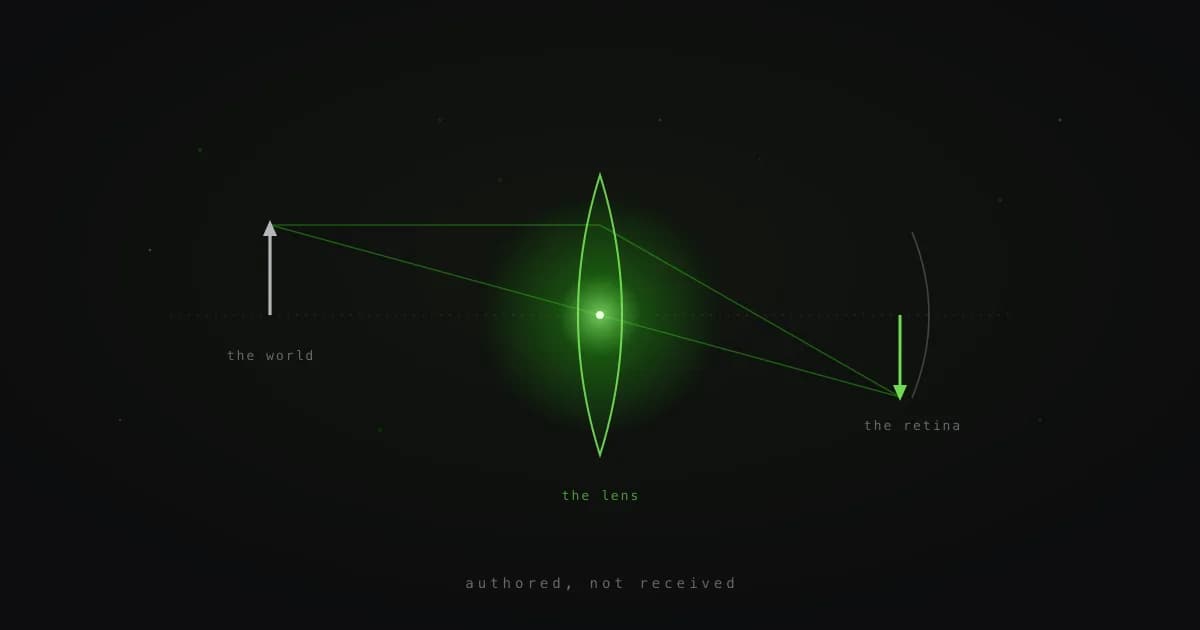
the reason none of this is obvious is that we're fish in water. we don't perceive the medium we're suspended in. we call air empty even though it fills the space, even though the space between atoms isn't really empty either. perception is bound to scale. what looks like nothing to us might be the whole world to something larger or smaller, and what we call the world might be background to it
the thread running through all of it is self-organization. at every level, parts respond to each other's states, information moves, the system adjusts itself with no one standing outside it pulling the strings. that's true of a cell and it's true of an ecosystem and it's true, in its own way, of whatever the galaxy is doing. i think that capacity, stuff registering and responding to stuff and arranging itself because of it, is where i'd locate consciousness. not as a thing poured in from above, but as something that comes with the territory of being a system at all
we are nothing, but part of it, that
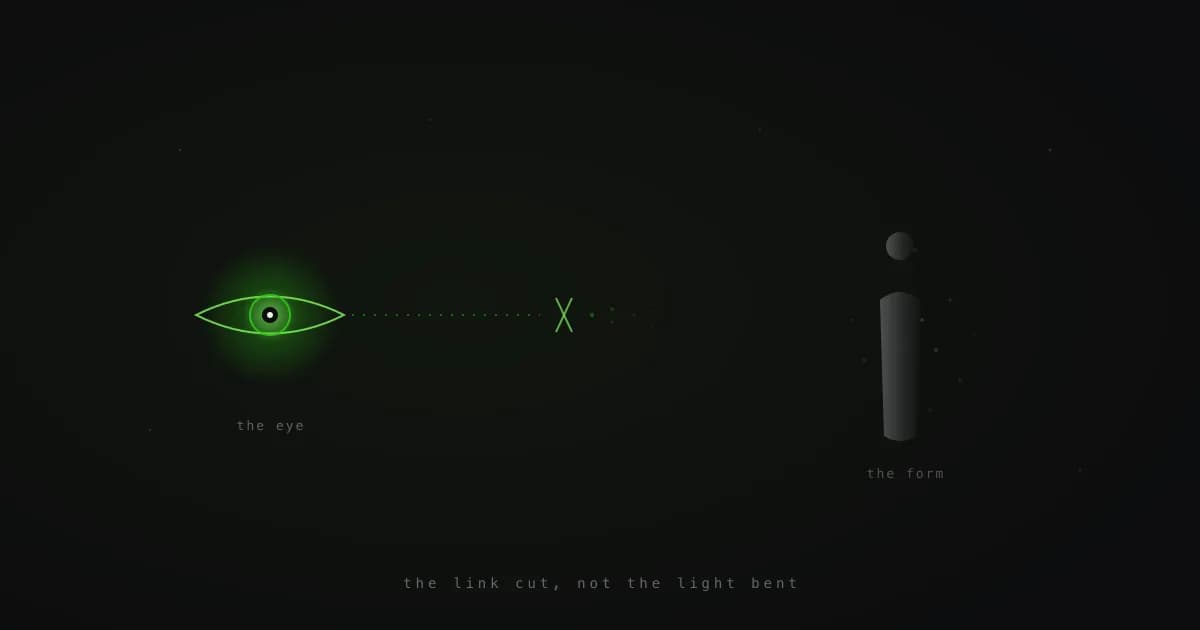
here's the part i won't pretend. i can't prove any of this from the inside. the inside of anything that isn't me is sealed off, i suppose permanently. i can't get into a water molecule to check whether the lights are on, and the strange thing is i can't really do it for another person either, i just infer it from the outside and trust the inference. so when i say the atom has some level of consciousness, i'm not claiming proof, and i know that someone who says the atom has none can't prove that either. the question might be one that no one standing at any single level ever gets to answer
so this is a theory i hold openly. the structure i'm confident about, the nesting is real, you genuinely are a colony that feels like an individual, and you're a piece of something larger you'll never see the edges of. what i can't hand anyone is certainty about the inner side, whether there's something it's like to be a cell, a planet, an atom. i lean toward yes, that consciousness is the rule and not the exception, that it scales in both directions and just wears a face we can't recognize from here. but i hold it as a lean, not a verdict, because the honest position is that no one can know, and any theory that forgets that is pretending to a view from nowhere that none of us actually have
where this has been somehow said before
older roots: Indra's net in Hua-yen Buddhism, every jewel reflecting every other, and Advaita Vedanta's one consciousness underlying everything, with each of us a local view of it
Gottfried Leibniz: in the Monadology he made reality out of "monads," tiny perceiving units, each one mirroring the whole universe from its own point of view
Gustav Fechner: the 1800s physicist who argued in Nanna and Zend-Avesta that plants, the Earth, and the stars all have inner lives, that soul reaches up the scale, not just down
Alfred North Whitehead: Process and Reality rebuilt the world as made of momentary "occasions of experience" at every level instead of dead matter, the "they behave like they're alive" hunch turned into a full metaphysics
Arthur Koestler: coined "holon" in The Ghost in the Machine for anything that is a whole and a part at once, and "holarchy" for the nesting of them, which is your body / organ / cell / molecule ladder almost exactly
Pierre Teilhard de Chardin: in The Phenomenon of Man he argued consciousness rises as matter organizes itself more deeply, climbing toward a cosmic point, your self-organization thread nearly line for line
James Lovelock: the Gaia hypothesis, Gaia: A New Look at Life on Earth, treats the planet as one self-regulating living system
Jakob von Uexküll: gave us the "umwelt," the idea that every creature is sealed inside its own perceptual world and can't step out of it, which is the fish in water put into biology
Thomas Nagel: "What Is It Like to Be a Bat?" is the locked-room point, that the inside of another being is something you can never actually reach
Galen Strawson and Philip Goff: the modern panpsychists, Strawson's Realistic Monism and Goff's Galileo's Error, both arguing mind goes all the way down to the particle
William James: worth naming for the objection, in The Principles of Psychology he raised the "combination problem," how little minds could ever add up into a big one, the knot none of this has cleanly untied