the invisibility sutra, read as attention and not optics

patanjali's yoga sutras list a power of disappearance. for two thousand years it got read as becoming see-through. but the sanskrit never actually says light bends around the body, it says the link between the seen thing and the seeing eye gets cut. that is a claim about perception, not about photons, and it survives scrutiny in a way the optical reading does not. below is the source, the spread of translations, and the case that what the text describes is a trainable skill of becoming attentionally negligible rather than literally invisible
the source text
the relevant line is book 3 (vibhuti pada), sutra 21. some manuscripts add a parallel line, 3.22, applying the same logic to sound
devanagari: कायरूपसंयमात् तद्ग्राह्यशक्तिस्तम्भे चक्षुःप्रकाशासंप्रयोगेऽन्तर्धानम् ॥२१॥
transliteration: kāya-rūpa-saṁyamāt tad-grāhya-śakti-stambhe cakṣuḥ-prakāśa-asaṁprayoge 'ntardhānam
word by word:
kāya: the body
rūpa: form, visible appearance
saṁyamāt: through samyama (the combined practice of concentration, meditation, absorption, defined back in 3.4)
tad-grāhya-śakti: the power by which that (form) is grasped or apprehended, i.e. the perceiving capacity in the observer
stambhe: on the suspension or checking of
cakṣuḥ: the eye
prakāśa: light
asaṁprayoge: on the absence of contact, the disjunction
antardhānam: disappearance, vanishing, invisibility
read literally and without romance, the structure is: by samyama on the body's form, when the apprehending power is suspended, there being no contact between eye and light, disappearance follows. notice the two conditions are not "the body emits no light." they are "the apprehending power is checked" and "eye and light are disjoined." the action is sited at the join between object and perceiver, not at the surface of the body
the spread of translations
what is striking is that serious translators split into two camps, and the split tracks exactly the distinction between optics and attention
the optical-leaning readers treat it as light physically failing to reach the eye. taimni glosses it through the tanmatra system, where the yogi manipulates the subtle force connecting form, light and the eye so the body's light never reaches the observer. satchidananda keeps it concrete, samyama on the body's form intercepts light from the observer's eyes so the body becomes invisible. this is the reading that later gets defended with appeals to "modern science," a body is visible when reflected light hits the eye, block that and it vanishes. the problem is that nothing in a nervous system can stop a body reflecting light, so this reading quietly requires magic to land
the perceptual-leaning readers locate the effect in the observer's mind, not in the light. hariharananda says perceptibility of the body is suppressed, the body gets beyond the sphere of the eye's perception. bouanchaud renders it as mastery of physical appearance that dissociates the observer's gaze from one's own emanations. desikachar goes furthest in this direction, describing it as merging with one's surroundings so that one's form becomes indistinguishable. that last one is not invisibility at all, it is camouflage by non-salience, you stop being a figure and become ground
so the translation history itself contains the argument. the camp that reads it optically has to lean on a mechanism that does not exist. the camp that reads it perceptually describes something we can actually name
the sound line as corroboration
3.22 in the manuscripts that carry it applies the identical move to hearing, samyama on sound disjoins ear from sound and the practitioner becomes inaudible, silent to others. if the original claim were really "deflect photons," the parallel would have to be "absorb all sound waves," which is even more absurd physically. but if the original claim is "drop out of the observer's perceptual uptake," then sound and sight are just two channels of the same skill, and the parallel makes perfect sense. the structure of the text points at perception as the real subject, the senses are listed as channels into a mind, not as physics to be overridden
the attention-negligibility reading
here is the version that does not need magic, and it maps the sanskrit better than the optical one does
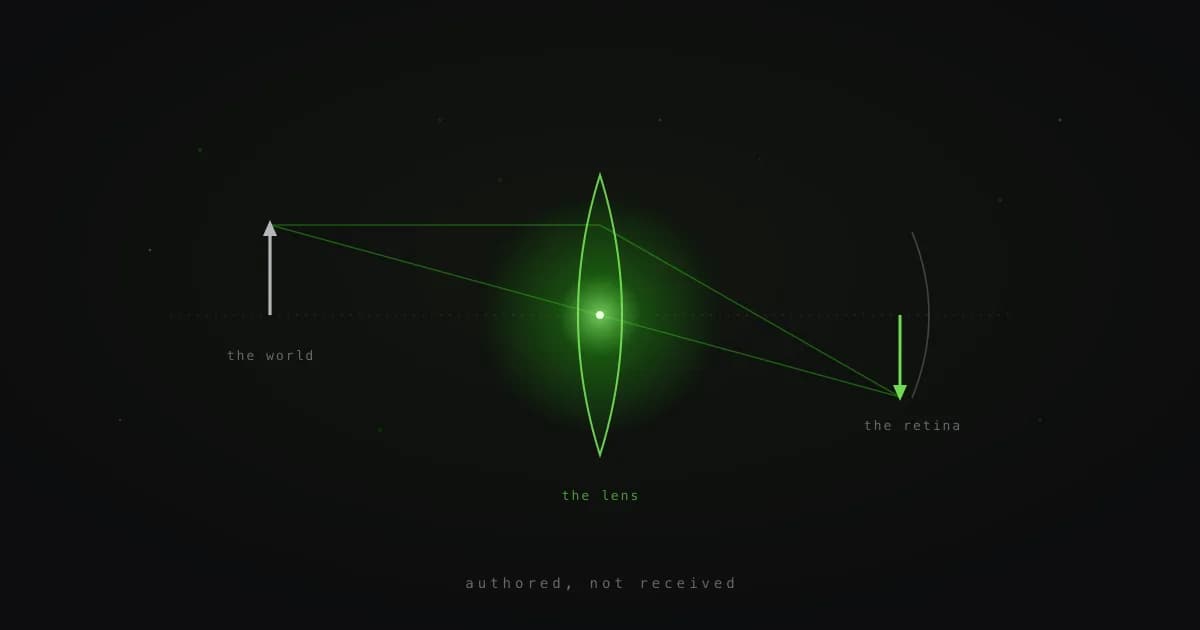
attention is a filter, not a camera. the eye takes in far more than the mind ever encodes, and what gets encoded is gated by salience, what moves, what contrasts, what is behaviorally relevant to the watcher. the experimental literature on this is solid. inattentional blindness is real and robust, people fixated on a task fail to register obvious objects in plain view, the famous case being observers who miss a person in a gorilla suit walking through a scene they are staring straight at. attention has a queue and most of the visual field never reaches awareness
now read the sutra against that. tad-grāhya-śakti-stambhe, the suspension of the apprehending power, is not light failing to arrive, it is the observer's encoding failing to fire. that is precisely what inattentional blindness is, the apprehending power present but not engaged. a practitioner with extreme control over their own body could plausibly drive this from the other side:
stillness: the eye's periphery is a motion detector first and a form detector second. micro-movements, fidgets, shifts of weight, these are what recruit involuntary attention. someone who can hold genuine physical stillness removes the single strongest trigger for being noticed
flattened salience: salience is contrast against a background, in posture, in behavior, in affect. a person who flattens their behavioral signature, no abrupt gestures, no attention-seeking affect, no narrative interest, drops down the watcher's priority queue and can fall out of it entirely
timing: attention is a resource that gets spent and depleted. acting in the windows when an observer's attention is loaded elsewhere is the difference between being encoded and being missed
none of this is invisibility. it is becoming negligible, ceasing to be the kind of thing a given mind bothers to encode. and the contemplative training that the sutra sits inside, years of attention control and interoceptive mastery, is exactly the training that would let someone manage their own salience with a precision most people never approach. the skill the text describes is upstream of the trick, the disappearance is a downstream effect in someone else's attention
the honest cut
two things keep this from being mysticism
first, the effect lives entirely in the observer's cognition, never in the light. the moment anyone claims the body itself stops reflecting photons, the claim is dead, that is not something attention training can buy and no femto-scale field a body emits could do it either. the perceptual reading works precisely because it never touches optics
second, the effect is bounded by the observer. a watcher who is actively searching for you, primed and unloaded, encodes you anyway. attention negligibility works on the inattentive, not on the alert. that boundary is not a flaw to be explained away, it is the falsification line, it is what makes this a real skill with limits rather than a power that conveniently cannot be tested. any version of the claim that adds "except it also works on people who are watching for you" has left the trainable skill behind and gone back to magic
read this way the sutra is not promising you can vanish. it is describing, in the vocabulary available to it, the upper end of a real human capacity, controlling your own salience well enough to slip beneath another mind's threshold for noticing. that is the part of the old claim that is true, and it is more interesting than the photon fantasy it usually gets mistaken for